The Archive
Tomatâ
du Plenty
1948 — 2000
The Archive
1948 — 2000
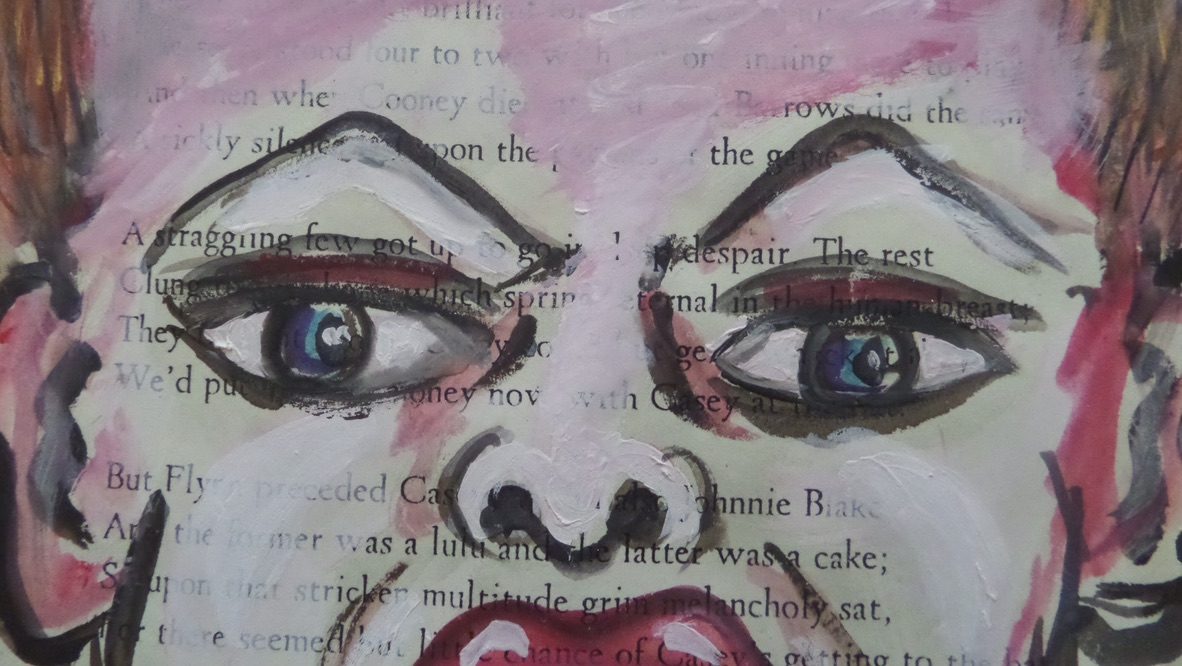
Tomatâ du Plenty, Tomatâ Screamers (self portrait), 1999. Mixed media on paper, 9½ × 8 in.,
painted on a page torn from Ernest Thayer's Casey at the Bat: A Ballad of the Republic Sung in the Year 1888.
Carlos Iglesias Collection. Reproduced in the program for Boxers and Backbeats,
Georgia Museum of Art, 2014. Pending estate authorisation.
He was born David Xavier Harrigan in New York in 1948, ran away to Hollywood at fifteen, and spent the next thirty-five years becoming several different people in public.
A Ze Whiz Kid in Seattle. A Cockette in San Francisco. Then the frontman of the Screamers — the Los Angeles band that replaced guitars with keyboards, became the most talked-about act in the city, and never released a record. What survives of them is a logo, some video, and the memory of people who were in the room.
When the Screamers ended in 1981 he picked up painting — the story goes that he found a kit of paints in an alley off Hollywood Boulevard — and kept at it until he died in 2000 — watercolour portraits, then boxers, entertainers, faces worked over whatever was at hand, including the pages of books. That work scattered into private hands across four decades and three coasts. Much of it has never been catalogued. Some of it is in a garage.
The people who knew Tomatâ are in their seventies and eighties. The paintings are on walls belonging to people who may not know what they have, or who got it from a friend of a friend and never wrote it down.
An archive is not a pile of pictures. What makes material usable — in a book, in a film, in a museum — is knowing where it came from and who can vouch for it. That part lives only in memory, and memory has a deadline.
So we record both: the object, and the chain of hands it came through.
His work is held in the permanent collection of the Georgia Museum of Art, and in private collections across the country — musicians, designers, writers, and friends who bought a picture for twenty-five dollars because he would rather sell a hundred of those than one for two and a half thousand.
Do you have something of his?
You keep everything you own. You choose how far your permission goes, and you can narrow it later. Nothing is sold or licensed on.
Contribute to the archive